What Is Pool Clarifier? Restore Crystal-Clear Water
Pool clarifier explained for UK hot tub owners: discover how clarifiers work, types available, usage tips, common mistakes, and safe alternatives.
Finding your hot tub filled with cloudy water can put a damper on any relaxing evening, leaving you searching for quick fixes that often disappoint. For many British hot tub owners, understanding the true role of a pool clarifier is key to lasting clarity. Clarifiers work by gathering tiny suspended particles so your filter can capture them, rather than chemically cleaning the water. This guide explains what clarifiers actually do, clears up common misconceptions, and helps you choose the most effective solution for your spa.
Table of Contents
- Pool Clarifier Defined And Common Misconceptions
- Types Of Pool Clarifiers For Hot Tubs
- How Pool Clarifiers Work In Practice
- When And How To Use Clarifier Safely
- Risks, Mistakes, And Effective Alternatives
Key Takeaways
| Point | Details |
|---|---|
| Understanding Clarifiers | Clarifiers assist filtration by binding small particles but do not clean water directly. |
| Common Misconceptions | They do not provide instant clarity and should not replace regular filtration. |
| Choosing the Right Type | Select clarifiers based on your hot tub’s specific needs and filtration system compatibility. |
| Safe Usage Practices | Test water chemistry before use, and follow dosing instructions to avoid overdosing and ensure effectiveness. |
Pool Clarifier Defined And Common Misconceptions
A pool clarifier is a chemical treatment that bundles together tiny suspended particles floating in your water, making them heavy enough for your filter to catch. It doesn’t directly clean the water; instead, it acts as a helper that improves filtration efficiency.
Many people misunderstand what clarifiers actually do. The biggest misconception? That clarifiers instantly transform murky water into crystal clarity. That’s not how they work in reality.
What Clarifiers Actually Do
Clarifiers function through a process called coagulation. They bind microscopic particles that are too small for standard filters to capture, creating larger clumps that your filtration system can trap and remove.
Think of it like gathering scattered marbles. Your filter captures the pile; the clarifier helps you create the pile in the first place.
According to health and safety guidance on pool clarifiers, these chemicals are essential tools for coagulating suspended particles, allowing easier removal through filtration rather than providing direct chemical cleaning.
Common Misconceptions Explained
These myths mislead many pool owners:
-
“Clarifiers clear water instantly.” They work over several hours or days as particles accumulate and your filter removes them.
-
“Clarifiers replace proper filtration.” Your filter does the actual work; clarifiers simply assist by enlarging particles.
-
“One dose fixes all water problems.” Clarifiers address cloudiness from suspended solids, not algae, bacteria, or chemical imbalances.
-
“Clarifiers work alone.” They require a functioning filtration system and appropriate backwashing schedules to be effective.
Clarifiers gather particles so filters can capture them, rather than directly cleaning water chemically.
According to pool plant operator training standards, misconceptions about clarifier roles are common, but understanding their true function as particle gatherers rather than direct water cleaners is essential for proper pool maintenance.
Why This Matters For Your Hot Tub
Clarifiers work best when you understand their role. They’re particularly useful when your water becomes cloudy from dust, debris, or bather load rather than from chemical issues.
Using them correctly means you’ll spend less time fighting cloudiness and more time enjoying your spa.
Pro tip: Test your water balance before adding clarifier - if alkalinity or pH is off, a clarifier won’t help. Fix chemistry first, then use clarifier if particle cloudiness remains.
Types Of Pool Clarifiers For Hot Tubs
Not all clarifiers work equally well for hot tubs. Your spa has unique characteristics - smaller volume, higher temperatures, more intensive use - that demand specific treatment types.
Choosing the right clarifier matters because the wrong one can waste money or fail to deliver results when you need clarity most.
Polymer-Based Clarifiers
Polymer clarifiers work by releasing long-chain molecules that attract suspended particles and bind them together. They’re versatile and work well across different water conditions.
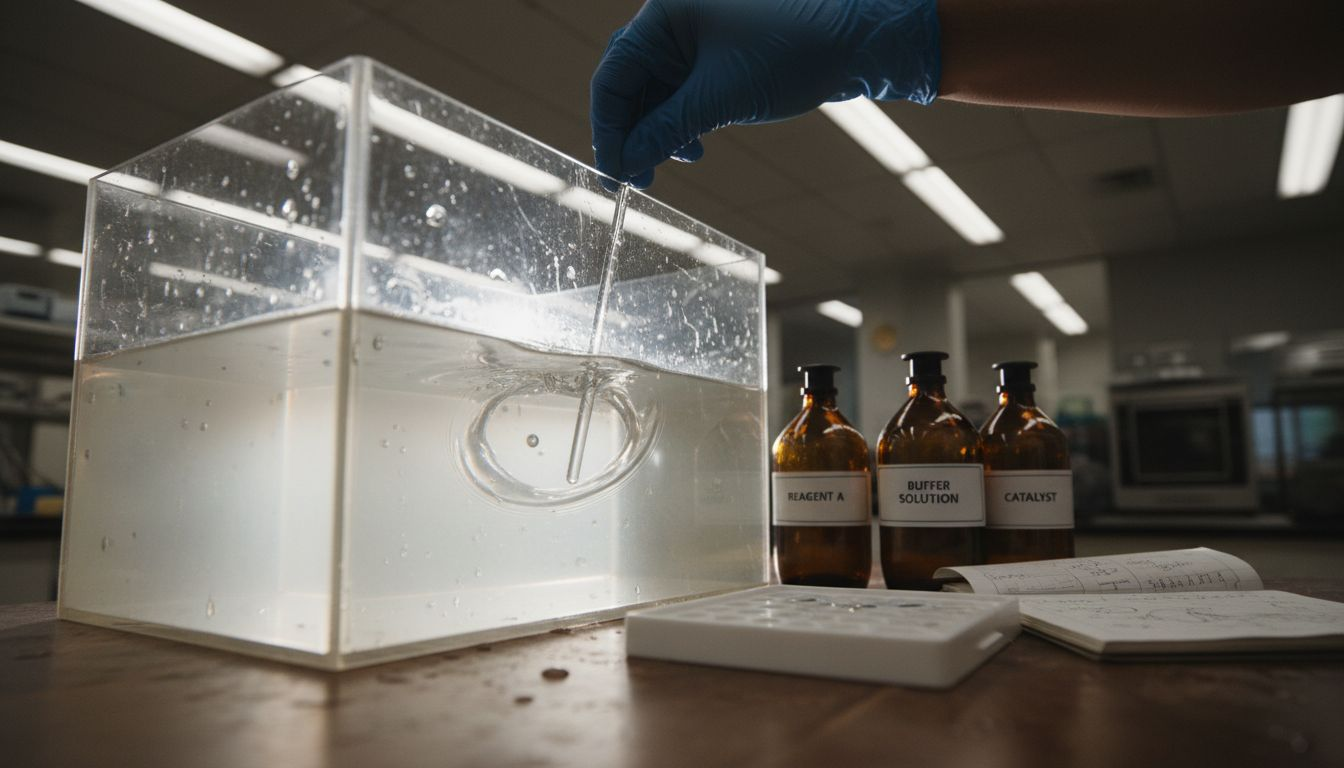
These clarifiers suit larger systems and pools with variable water chemistry. They’re also relatively forgiving if your dosing isn’t perfectly precise.
Key advantages include:
- Fast-acting results within hours rather than days
- Effective across a wide pH range
- Compatible with most filtration systems
- Less likely to cause overdosing problems
Metal-Based Clarifiers
Metal-based clarifiers, often containing aluminium compounds, are particularly effective for smaller water volumes like hot tubs. According to clarifier types for pool systems, metal-based clarifiers are specifically highlighted as suited for spa and hot tub applications.
These work by coagulating particles at a molecular level, creating heavier clumps that settle or filter quickly.
For hot tubs specifically:
- More concentrated formulations suit smaller volumes
- Rapid results in compact systems
- Excellent for regular use in high-demand spas
- Requires more careful dosing to avoid residue buildup
Specialty Clarifiers For Spas
Some clarifiers are formulated specifically for spa pools. According to infection control in spa-pool systems, specialised clarifier types designed for spa pools maintain water clarity whilst addressing safety concerns unique to smaller heated systems.
These account for bromine or chlorine compatibility and the rapid contamination cycles in hot water.
To clarify the differences between pool clarifier types for hot tubs, see the comparison below:
| Clarifier Type | Ideal Water Condition | Application Speed | Risk of Overdosing |
|---|---|---|---|
| Polymer-Based | Variable pH and chemistry | Moderate to fast | Low |
| Metal-Based | Small volume, high demand | Very fast | Higher, needs accuracy |
| Specialty Spa | Spa-specific chemistry | Fast and consistent | Controlled, spa tested |
Metal-based clarifiers work best for hot tubs because they’re formulated for smaller water volumes and faster turnover rates.
Choosing The Right Type For Your Spa
Consider your current filtration system first. Some clarifiers work better with sand filters; others pair well with cartridge systems.
Also factor in your water chemistry maintenance. If you regularly balance alkalinity and pH, polymer clarifiers offer flexibility. If you prefer simpler treatments, metal-based options deliver faster results.
Your usage pattern matters too. High-use spas benefit from metal-based clarifiers that work quickly between bather sessions.
Pro tip: Start with the clarifier type recommended by your hot tub manufacturer - they’ve already tested compatibility with your specific system and filtration design.
How Pool Clarifiers Work In Practice
Pool clarifiers operate through a simple but effective chemical process. They don’t magically transform murky water - instead, they work alongside your filtration system to remove suspended particles that make water look cloudy.
Understanding how this process unfolds helps you use clarifiers correctly and get consistent results every time.
The Coagulation Process
Coagulation is the technical term for what happens when you add clarifier. The chemical causes tiny suspended particles to clump together into larger, heavier aggregates that your filter can actually capture.
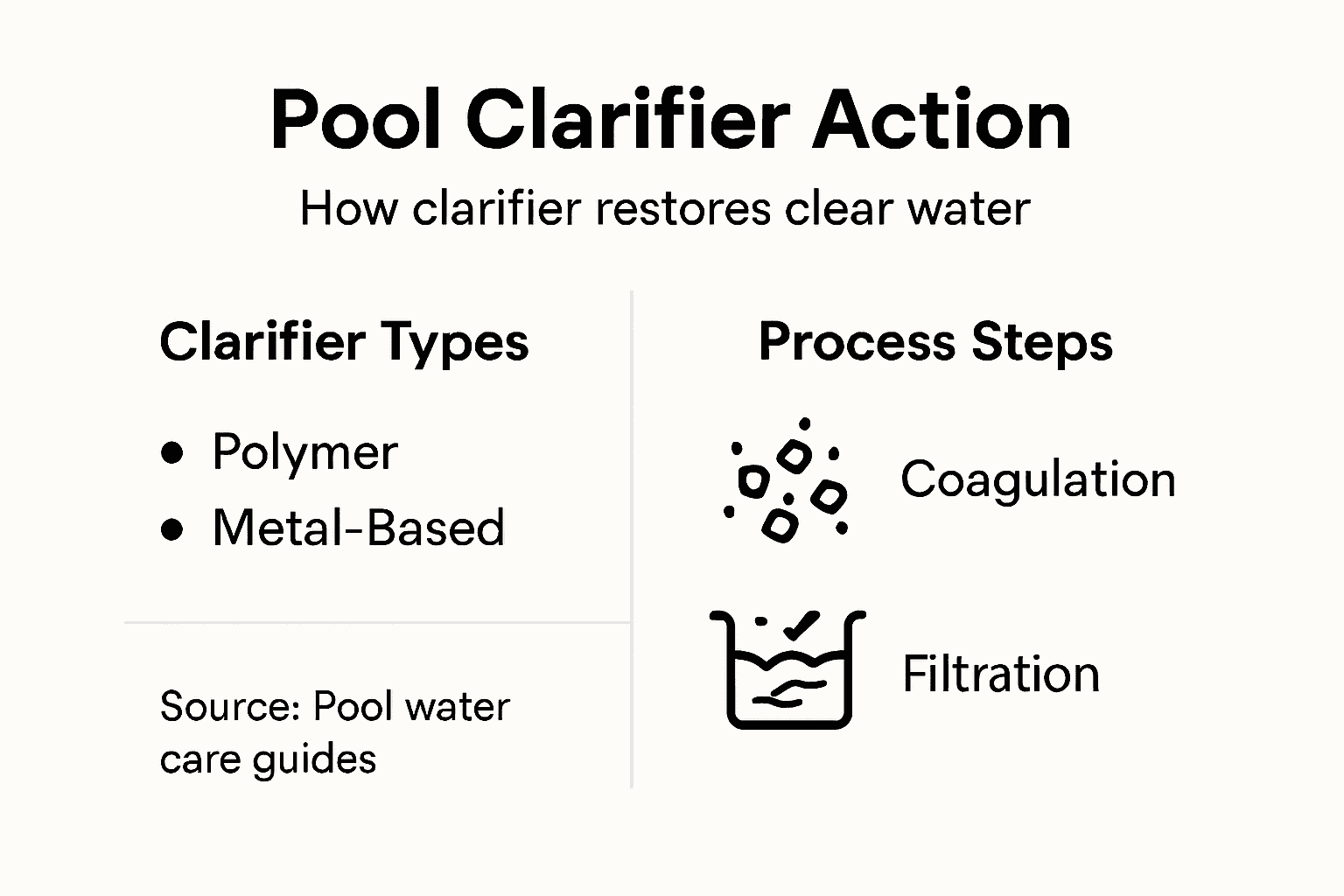
Think of it as bringing scattered dust particles together into a ball. Once grouped, they become large enough for your filter to trap and remove.
According to pool clarifier coagulation in water management, clarifiers function by coagulating microscopic particles into larger aggregates that filters can trap, directly improving water clarity and filtration efficiency.
Step-By-Step: What Happens After You Add Clarifier
The process unfolds over hours, not minutes:
- Chemical injection - You add the clarifier dose according to your water volume
- Particle attraction - The chemical molecules spread through water and bind to suspended particles
- Clump formation - Particles stick together, growing heavier and larger
- Filter capture - Your filtration system traps the enlarged clumps during normal circulation
- Water clearing - As the filter removes clumps, clarity visibly improves
Timing Matters
Clarifiers typically require 4 to 24 hours to show visible results, depending on your water volume and filter size. Smaller hot tubs usually clear faster than large pools.
You’ll notice the biggest improvement after one complete filtration cycle - roughly 8 hours for most residential spas.
Clarifiers assist your filter by making particles easier to trap, rather than chemically sanitising water directly.
The process depends on your filter running continuously. If you turn off circulation between treatments, clarifiers can’t work effectively because particles won’t reach the filter.
Common Mistakes That Reduce Effectiveness
These errors prevent clarifiers from working properly:
- Adding too much - Overdosing creates cloudiness instead of clearing it
- Poor timing - Adding clarifier right before backwashing wastes the dose
- Skipping circulation - Your filter must run constantly for coagulation to complete
- Ignoring water balance - Imbalanced pH or alkalinity prevents proper particle binding
Understanding why pool water turns cloudy helps you identify whether clarifier is the right solution or whether you need different treatment first.
Maximising Results In Your Hot Tub
Your spa’s smaller volume means clarifiers work faster than in pools. Results often appear within 6 to 12 hours rather than a full day.
Hotter water also speeds the process slightly, though this effect is minimal. The key difference is your lower total water volume.
Pro tip: Add clarifier in the evening, keep circulation running overnight, and wake to crystal-clear water by morning - one of the easiest ways to maintain consistent clarity between deep cleans.
When And How To Use Clarifier Safely
Using clarifier correctly means getting results without creating new problems. Safety matters - both for you handling the chemical and for anyone using your hot tub afterwards.
Proper technique prevents overdosing, chemical imbalances, and health hazards that careless application can cause.
Before You Add Clarifier
Test your water chemistry first. pH and alkalinity must be balanced before clarifier can work effectively.
If your water is too acidic or alkaline, clarifier won’t bind particles properly. You’ll waste the product and remain frustrated with cloudiness.
According to safe pool clarifier handling procedures, correct dosage and proper application timing within the maintenance cycle are essential to avoid chemical imbalances.
Check these readings:
- pH between 7.2 and 7.6
- Alkalinity between 80 and 120 ppm
- Sanitiser levels appropriate for your system
Safe Handling Steps
Following proper procedure protects you and your water quality:
- Read the label - Manufacturer instructions vary by product type
- Measure accurately - Use the dosing cup provided; don’t estimate
- Wear gloves - Clarifiers can irritate skin with prolonged contact
- Dilute if needed - Some products require mixing with water first
- Distribute evenly - Pour around the spa perimeter, not in one spot
- Keep circulation running - Start your filter immediately after dosing
Timing Your Application
Add clarifier before you backwash your filter. If you backwash immediately after dosing, you’ll waste the chemical without benefit.
Ideal timing is early evening. This allows 8 to 12 hours of filtration overnight, and you’ll see results by morning.
Avoid adding clarifier right before shocking your system or adjusting pH. Space treatments by at least 12 hours to prevent chemical reactions.
Protective equipment and proper ventilation prevent health hazards when applying pool chemicals.
Dosage: Getting It Right
Calculate based on your actual water volume, not tank capacity. Most hot tubs hold less than manufacturers claim.
Overdosing is the most common mistake. Too much clarifier creates a white haze instead of clearing it. If this happens, run your filter continuously for 24 hours and do a partial water change.
Start with the minimum recommended dose. You can always add more; you can’t easily remove excess.
Safety Precautions
These practices protect you and your family:
- Store clarifier in a cool, dry place away from sunlight
- Keep away from children and pets
- Never mix with other chemicals
- Wear appropriate personal protective equipment when handling
- Ensure adequate ventilation in your spa area
- Never inhale fumes from chemical containers
Pool chemical safety guidance emphasises wearing protective equipment, following manufacturer instructions, and maintaining proper ventilation when applying clarifiers to prevent health hazards.
Pro tip: Keep a logbook of clarifier doses and dates - tracking what works prevents overdosing next time and helps you predict when you’ll need clarification again.
Risks, Mistakes, And Effective Alternatives
Clarifiers work brilliantly when used correctly. But mistakes happen. Understanding common pitfalls and alternatives helps you avoid wasting money or creating worse water problems.
Sometimes a different approach solves your cloudiness faster than clarifiers can.
Common Mistakes That Backfire
These errors undermine clarifier effectiveness or create new issues:
- Overdosing - Too much clarifier clouds water instead of clearing it
- Dirty filters - Clarifier can’t work if your filter is clogged with debris
- Applying during heavy use - New bathers add particles faster than clarifier can aggregate them
- Backwashing too soon - Removing the clarifier before it finishes working wastes the dose
- Ignoring chemistry first - Imbalanced pH prevents particles from binding together
- Using expired products - Old clarifiers lose potency and perform unpredictably
According to pool clarifier application risks and effectiveness, improper clarifier use including overdosing and application during heavy use reduces effectiveness, whilst applying clarifier when filters are dirty prevents proper particle removal.
Here’s an at-a-glance reference for clarifier use mistakes and their impact:
| Mistake | Immediate Consequence | Long-Term Risk |
|---|---|---|
| Overdosing clarifier | Haziness increases | Filter clogs, residue |
| Dirty filter | Clarifier cannot work | Persistent cloudiness |
| Poor timing | Dose wasted, no improvement | Higher maintenance |
| Ignoring water balance | Clarifier fails to bind | Chronic clarity issues |
Health And Safety Risks
Mishandling clarifiers poses real dangers. Chemical overdoses irritate eyes, skin, and respiratory systems for anyone in or near your spa.
Stored improperly, clarifier degrades or becomes hazardous. Never mix with other chemicals or sanitisers - dangerous reactions can occur.
Effective Alternatives Worth Considering
Clarifiers aren’t your only option for crystal-clear water:
- Improve filtration - Clean filters and more frequent backwashing often clear cloudiness without chemicals
- Use flocculants - These heavy particles settle to the bottom faster than clarifiers work; vacuum them out overnight
- Enzymatic cleaners - Break down organic compounds causing cloudiness from lotions or cosmetics
- Regular vacuuming - Prevents debris from staying suspended and breaking down into particles
- UV or ozone systems - Advanced technologies that reduce reliance on chemical clarifiers
When Clarifiers Make Sense
Clarifiers excel when your water is cloudy from fine suspended solids but your chemistry and filtration are working properly.
They’re less helpful if your real problem is algae, bacteria, or chemical imbalance. Identify the root cause first.
Regular filtration and maintenance prevent most cloudiness before clarifiers become necessary.
Combination Approach
The best results come from combining methods. Clean your filter, test chemistry, balance pH and alkalinity, then add clarifier only if cloudiness persists.
This methodical approach costs less long-term and solves actual problems rather than masking symptoms.
Knowing When To Stop
If cloudiness returns within days after clarification, something else is wrong. Investigate before adding more clarifier.
Repeated clarification signals a filter problem, chemistry imbalance, or excessive organic load that chemicals alone can’t fix.
Pro tip: Keep your filter clean and chemistry balanced first - you’ll use clarifier only occasionally for stubborn cloudiness rather than becoming dependent on it.
Restore Your Hot Tub Water Clarity with ClearSpa
Cloudy water from suspended particles can be a frustrating challenge when maintaining your hot tub. The article outlines how pool clarifiers work by coagulating microscopic debris into larger clumps that your filter can easily remove. To achieve that perfect crystal-clear water you desire, balancing your pH and alkalinity first is essential, followed by selecting the right clarifier type and proper filtration.
Enhance your spa experience today with ClearSpa, your trusted source for high-quality water treatment products. We offer a carefully formulated range of hot tub chemicals and spa essentials to tackle cloudiness and keep your water pristine. Discover products designed specifically for efficient coagulation and filtration support. Don’t wait until cloudiness returns - visit ClearSpa now to find everything you need to maintain sparkling clear water effortlessly.
Frequently Asked Questions
What is a pool clarifier and how does it work?
A pool clarifier is a chemical treatment that binds tiny suspended particles in water, making them heavy enough for your filtration system to capture. It does not directly clean the water but improves filtration efficiency.
How quickly can I expect to see results after adding a clarifier?
Results can typically be seen within 4 to 24 hours, depending on water volume and filter size. Smaller systems like hot tubs usually clear faster than larger pools.
Can I use any type of clarifier in my hot tub?
Not all clarifiers are suitable for hot tubs. Polymer-based and metal-based clarifiers are often recommended for spas due to their effectiveness in smaller volumes and higher temperatures.
What should I do if my water remains cloudy after using a clarifier?
If cloudiness persists, check your water chemistry and filtration system. Ensure pH and alkalinity are balanced first, as imbalanced water can prevent proper particle binding. If necessary, consider alternative treatments or consult a professional.