Essential Hot Tub Water Treatment Steps for Sparkling Clean Water
Treat hot tub water in order: test, correct total alkalinity (80-120 mg/l), then pH (7.2-7.6), then sanitiser (3-5 mg/l chlorine or 4-6 mg/l bromine), shock weekly and rinse the filter weekly. Sample 30 cm below the surface and retest after dosing before anyone bathes.
Hot tub water treatment steps: test, balance, sanitise, shock, clean filter, verify. UK dosing ranges, timings and products for clear water.
To treat hot tub water and keep it crystal clear, work through six steps in order every week: test the water, balance total alkalinity then pH, sanitise with chlorine or bromine, shock to burn off contaminants, clean the filter, then verify clarity. Get the order right and dose to the ranges below and you will avoid cloudy water, itchy skin and scale damage. This UK guide gives you the exact figures, timings and products to use.
Warm water (typically 37-40°C) is the perfect home for bacteria, and organic load builds fast after every soak. In the UK, the HSE flags Pseudomonas aeruginosa and Legionella as the key risks in spa pools, which is why a consistent, measured routine matters far more than the odd deep clean.[1]
Table of Contents
- Step 1: Test Your Water Chemistry Levels
- Step 2: Balance Alkalinity and pH Levels
- Step 3: Sanitise Your Hot Tub Water
- Step 4: Shock The Water To Remove Contaminants
- Step 5: Clean Filters And Maintain Equipment
- Step 6: Verify Water Clarity And Safety
- Frequently Asked Questions
Quick Summary
| Parameter | Target Range | How Often |
|---|---|---|
| pH | 7.2-7.6 (ideal 7.4) | Test every 2-3 days |
| Total alkalinity | 80-120 ppm | Test weekly |
| Free chlorine | 3-5 ppm | Test before every use |
| Bromine | 4-6 ppm | Test before every use |
| Calcium hardness | 100-250 ppm | Test monthly |
| Shock treatment | Weekly (plus after heavy use) | Evening / after parties |
Step 1: Test Your Water Chemistry Levels
Every treatment decision starts with an accurate reading, so testing is the foundation of clear, safe water. Test the free chlorine or bromine and pH at least every 2-3 days, and check total alkalinity and calcium hardness weekly. Test more often in summer, when higher UK temperatures and heavier bather loads burn through sanitiser faster.
Use fresh 6-in-1 water test strips for a quick daily check, or DPD tablets in a photometer when you want laboratory-grade accuracy. Whatever you use, replace strips before their expiry date; strips stored in a damp, warm spa cabinet degrade and give false readings. For a full walkthrough, see our guide on how to test hot tub chemicals.
Collect your sample from about 30 cm below the surface, elbow-deep and away from the return jets, so you capture representative water rather than freshly dosed water. Dip the strip, hold it level for the stated time (usually 15 seconds), and read it against the chart in good daylight. Aim for these ranges:
- pH: 7.2-7.6 (7.4 is the sweet spot)
- Total alkalinity: 80-120 ppm
- Free chlorine: 3-5 ppm, or bromine 4-6 ppm
- Calcium hardness: 100-250 ppm
Write your results down (a phone note or logbook is fine). Trends over a fortnight tell you far more than any single reading, and they help you spot problems such as chlorine demand or rising alkalinity before the water clouds.
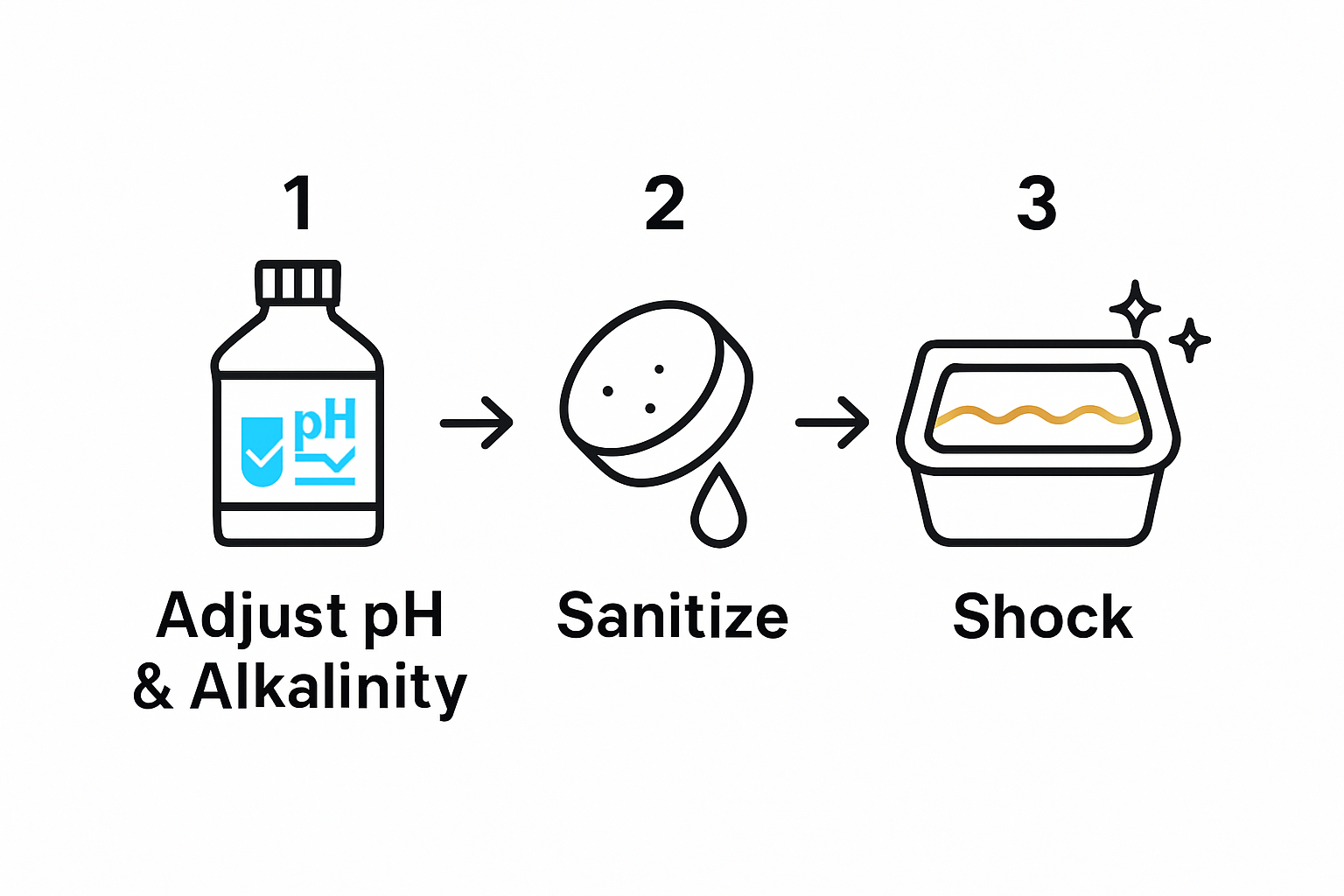
Step 2: Balance Alkalinity and pH Levels
Balance the water before you sanitise, because sanitiser simply works better in balanced water. Correct total alkalinity first, then pH, because alkalinity acts as a buffer that stops pH bouncing around. If you learn one thing here, learn the order of operations, and read our explainer on the role of spa balancing chemicals to understand why it matters.
If total alkalinity is below 80 ppm, raise it with a total alkalinity increaser (sodium bicarbonate), adding roughly enough to lift a 1,500-litre tub by 10 ppm at a time and retesting after circulation. If alkalinity is above 120 ppm, lower it with a pH/alkalinity reducer.
Once alkalinity sits in range, adjust pH. If pH is below 7.2, add a pH Plus (sodium carbonate); if it is above 7.6, use a pH/alkalinity reducer (sodium bisulphate). Add chemicals in small doses near a running jet, with the cover open, and always add chemical to water, never the other way round.
- Target pH: 7.2-7.6
- Target total alkalinity: 80-120 ppm
- Target calcium hardness: 100-250 ppm (raise if you are in a soft-water area to protect heaters and seals)
Run the jets for at least 15-20 minutes after dosing, then retest after a couple of hours. Gentle, incremental adjustments beat one big dose every time and stop you overshooting the range.
Step 3: Sanitise Your Hot Tub Water
Sanitiser is what actually kills bacteria, so this is the step that keeps you safe. The two mainstream choices in the UK are chlorine and bromine. Chlorine acts fast and is cost-effective; bromine is more stable at the higher temperatures and pH of a hot tub, so it is a popular choice for spas. If you are undecided, our chlorine vs bromine guide breaks down the trade-offs.
| Sanitiser | Target Range (ppm) | Main Advantages | Considerations |
|---|---|---|---|
| Chlorine | 3-5 | Fast-acting, cost-effective | Can be depleted quickly at 38-40°C |
| Bromine | 4-6 | Stable at high temperature and pH, low odour | Slower to establish a reserve, slightly pricier |
With the water balanced, hold free chlorine at 3-5 ppm or bromine at 4-6 ppm.[2] Add sanitiser near a running jet with the cover off, and never let free chlorine drop to zero, even overnight, as that is when bacteria and biofilm take hold. Ozone or UV systems can reduce your chemical use, but under UK guidance they supplement rather than replace a measurable residual sanitiser in the water.
- Chlorine: 3-5 ppm free chlorine
- Bromine: 4-6 ppm
- Test before every soak and top up as needed
Step 4: Shock the Water to Remove Contaminants
Shocking oxidises the invisible load your sanitiser struggles with: sweat, sun cream, skin oils and the combined chlorine (chloramines) that make water smell strongly of chlorine. Shock weekly as standard, and again after heavy use such as a party. See our hot tub maintenance checklist for how this fits your wider routine.
A non-chlorine shock (MPS) is ideal for regular weekly oxidising because you can usually get back in the water in around 15-20 minutes once it has circulated. A chlorine shock is stronger for clearing a neglected or cloudy tub, but you must wait until free chlorine falls back to 3-5 ppm, typically several hours or overnight, before soaking.
Confirm pH is 7.2-7.6 first, turn the air blower off, remove the cover and dose to the tub volume on the pack. Run the circulation pump for at least 20 minutes and leave the cover off for 20-30 minutes so gases can escape.
- Frequency: weekly, plus after heavy bather loads
- Non-chlorine shock: back in ~15-20 minutes
- Chlorine shock: wait until free chlorine returns to 3-5 ppm
Store all shock products in a cool, dry place, keep chlorine and non-chlorine products apart, and wear gloves and eye protection when dosing.
Step 5: Clean Filters and Maintain Equipment
Your filter removes the debris your chemicals cannot, so a clogged cartridge undermines every other step. Rinse the cartridge under a hose weekly, working top to bottom between the pleats to shift trapped grit. If your water clouds despite balanced chemistry, the filter is a prime suspect, as explained in our hot tub filter cleaning guide.
Every 3-4 weeks, soak the cartridge overnight (8-12 hours) in a filter cartridge cleaner to dissolve the oils and scale a rinse leaves behind, then rinse thoroughly and let it dry before refitting. Keeping a spare cartridge lets you rotate one while the other soaks, so filtration never stops.
While the filter is out, check the skimmer basket, look for scale on the jets and inspect pump seals and cover clips. Most spa water should be fully drained and refilled every 3-4 months, or sooner if the total dissolved solids climb and dosing stops working (a rough guide is to divide 40 by the number of daily bathers to estimate weeks between refills).
- Rinse cartridge: weekly
- Chemical soak: every 3-4 weeks
- Replace cartridge: every 12 months or when pleats stay grey
- Full drain and refill: every 3-4 months
Step 6: Verify Water Clarity and Safety
The final step confirms your work has paid off. Balanced, sanitised water should be completely transparent, letting you read the tub floor clearly, with no foam, film or odour beyond a faint sanitiser smell. If the water is cloudy despite in-range chemistry, check the filter and clarifier, and see our guide to the reasons for cloudy hot tub water.
Do a final test and confirm every parameter is in range: pH 7.2-7.6, total alkalinity 80-120 ppm, and free chlorine 3-5 ppm or bromine 4-6 ppm. Run your hand through the water; it should feel smooth, not oily or gritty, and the waterline should be free of scum and scale.
| Verification Item | What to Check | Ideal Outcome |
|---|---|---|
| Visual clarity | Tub floor visible | Completely transparent |
| Surface | Foam or floating particles | None present |
| Water feel | Run hand through water | Smooth, no oily film |
| Waterline | Scale, scum or staining | Clean surfaces |
| Chemistry | pH, alkalinity, sanitiser | All within range |
| Odour | Strong chlorine smell (chloramines) | Neutral or faint sanitiser smell |
Water safety is ongoing, not a one-off. A short, consistent weekly routine keeps your hot tub healthy and protects the equipment you have invested in.
Take the Stress Out of Hot Tub Water Care with ClearSpa
Struggled with cloudy water or dosing that never quite holds? Most problems trace back to skipping a step or guessing the dose. ClearSpa's UK-formulated chemicals are made to hit the exact ranges in this guide, so you can test, balance, sanitise and shock with confidence.
Stock up on the essentials, from 6-in-1 test strips and non-chlorine shock to a fresh filter cartridge cleaner, and make crystal-clear water your default rather than your goal.
Frequently Asked Questions
What are the key steps to treat hot tub water?
Test the water, balance total alkalinity then pH, sanitise with chlorine or bromine, shock weekly to remove contaminants, clean the filter, and verify clarity. Following the steps in this order gives the most reliable results.
How often should I test hot tub water?
Test free chlorine or bromine and pH every 2-3 days (and before every soak), total alkalinity weekly, and calcium hardness monthly. Test more often in summer or when the tub is used heavily.
What is the ideal pH for a hot tub?
Aim for pH 7.2-7.6, with 7.4 ideal. That range keeps sanitiser effective, protects equipment from scale and corrosion, and is comfortable on skin and eyes.
How often should I shock my hot tub?
Shock weekly as standard, and again after heavy use such as a party. Non-chlorine shock lets you soak again in about 15-20 minutes; after a chlorine shock, wait until free chlorine falls back to 3-5 ppm.
Why is my hot tub water cloudy even when the chemistry is balanced?
Cloudiness with in-range readings usually points to a dirty filter, high total dissolved solids near a refill, or fine particles that need a clarifier. Clean the cartridge first, then re-test and consider a full drain and refill if the water is several months old.
Sources and review
Reviewed on . Next review due .
- HSG282: The control of legionella and other infectious agents in spa-pool systems - Health and Safety Executive
- PWTAG Code of Practice: the management and treatment of swimming pool water - Pool Water Treatment Advisory Group