How do you raise alkalinity in a hot tub effectively
Learn how do you raise alkalinity in a hot tub naturally with this step-by-step guide for optimal water balance and comfort.
Most hot tub owners know that crystal clear water feels luxurious and inviting. Yet, the real culprit behind murky water and itchy skin is often something invisible to the eye. Did you know that if your hot tub’s alkalinity falls below 80 parts per million, your pH levels can go haywire and damage both your spa and your skin? Many people reach straight for more chemicals, but careful testing and measured adjustments are actually the secret to silky smooth and perfectly balanced hot tub water.
Table of Contents
- Step 1: Test Your Hot Tub Water’s Alkalinity Level
- Step 2: Calculate The Amount Of Alkalinity Increaser Needed
- Step 3: Add The Alkalinity Increaser To The Hot Tub
- Step 4: Allow The Water To Circulate
- Step 5: Re-Test The Alkalinity Level After Circulation
- Step 6: Adjust Further If Necessary
Quick Summary
| Key Point | Explanation |
|---|---|
| 1. Test alkalinity before adjustments | Always start with accurate alkalinity measurements using a digital testing kit for precise results. |
| 2. Calculate required increaser carefully | Know your hot tub’s volume and current alkalinity to determine the exact amount of sodium bicarbonate needed for adjustments. |
| 3. Disperse chemicals effectively | Run the hot tub’s circulation system while adding increaser to ensure an even distribution and prevent concentrated areas. |
| 4. Retest after circulation | Wait at least 30 minutes after circulation to retest alkalinity levels and verify they are within the ideal range. |
| 5. Make gradual adjustments only | If levels are still off, adjust in small increments and retest, preventing overcorrection which can disrupt water balance. |
Step 1: Test your hot tub water’s alkalinity level
Testing your hot tub’s water alkalinity is the critical first step in managing water chemistry effectively. Alkalinity acts as a buffer that stabilises pH levels, preventing rapid fluctuations that could damage your hot tub or create an uncomfortable bathing experience. Before you can raise alkalinity, you need precise measurements using a reliable testing kit.
To begin, acquire a digital water testing kit specifically designed for hot tubs. These kits provide more accurate readings compared to traditional test strips. You will want to collect a water sample from your hot tub approximately 30 centimetres below the water surface, away from water inlets or skimmer areas. Hold the collection container at arm’s length and submerge it inverted to ensure an uncontaminated sample.
Once you have your sample, follow the manufacturer’s instructions carefully for your specific testing kit. Most digital testing kits require you to insert test strips or use a digital probe to measure total alkalinity. The ideal alkalinity range for hot tubs sits between 80 and 120 parts per million (ppm). If your readings fall outside this range, you will need to take corrective action. Learn more about why total alkalinity matters in hot tub maintenance.
Pay close attention to your test results. Readings below 80 ppm indicate low alkalinity, which can cause pH levels to bounce around unpredictably. Conversely, levels above 120 ppm suggest high alkalinity, potentially leading to scale formation and cloudy water. By understanding these measurements, you are setting the foundation for balanced, healthy hot tub water that looks clear and feels great.
The following table summarises the essential tools and materials you need to accurately raise alkalinity in your hot tub, including their purpose and any special considerations.
| Tool/Material | Purpose | Notes/Specifications |
|---|---|---|
| Digital water testing kit | Accurately measures alkalinity and pH levels | Preferably hot tub-specific for precise results |
| Sodium bicarbonate (increaser) | Raises alkalinity level | Use according to manufacturer’s instructions |
| Clean measuring cup | Ensures correct dosage of chemicals | Dedicated to hot tub chemical use only |
| Protective gloves | Protects hands during chemical handling | Chemical-resistant gloves recommended |
| Safety glasses | Shields eyes from accidental splashes | Especially important when handling powders |
| Cleaning materials | Cleans spills or residue | Non-abrasive cloths or towels |
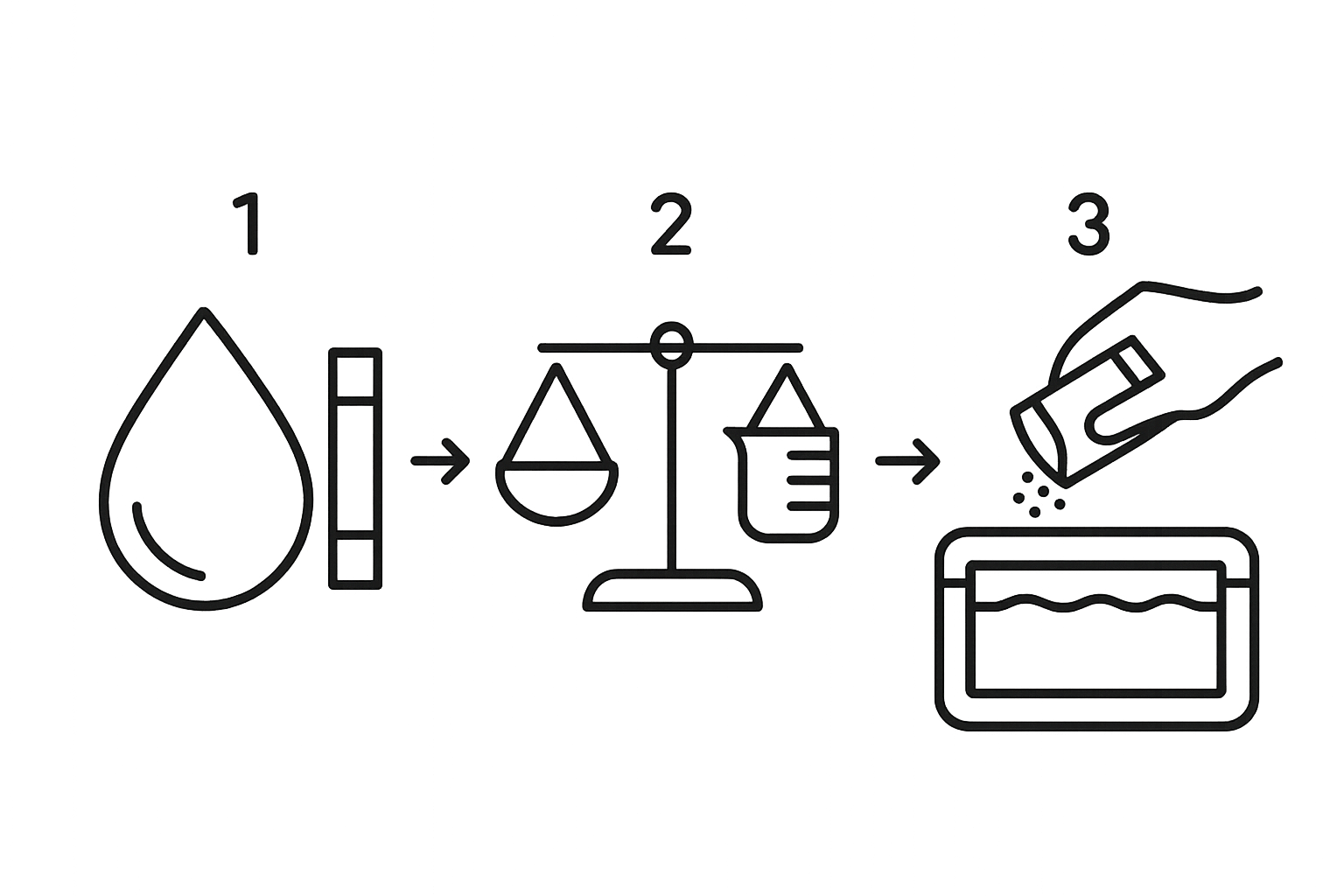
Step 2: Calculate the amount of alkalinity increaser needed
Calculating the precise amount of alkalinity increaser is crucial for achieving balanced hot tub water chemistry. This step requires careful measurement and consideration of your specific hot tub volume and current alkalinity levels. Check out our guide on total alkalinity increasers to understand the fundamentals of this process.
To determine the correct dosage, you will need to know your hot tub’s exact water volume in litres. Most residential hot tubs range between 600 and 1500 litres, so measuring accurately is essential. Multiply your test strip’s alkalinity reading by the total volume, then subtract the target alkalinity level of 100 ppm. This calculation will tell you exactly how much sodium bicarbonate or alkalinity increaser you need to add.
For example, if your hot tub contains 1000 litres of water and your current alkalinity reading is 60 ppm, you will need to increase it by 40 ppm. Typically, you will require approximately 80 grams of alkalinity increaser per 1000 litres to raise alkalinity by 10 ppm. Always read the manufacturer’s specific instructions, as product concentrations can vary. Measure the increaser carefully using a clean, dedicated measuring cup to ensure precision.
Work systematically and add the calculated amount of alkalinity increaser in small increments. After each addition, run your hot tub’s circulation system for at least 15 minutes to distribute the chemicals evenly. Wait 30 minutes, then retest the water to confirm you have reached the desired alkalinity level. Remember that overcorrection can be just as problematic as under-correction, so patience and careful measurement are key to maintaining perfect water balance.
Use the table below for a quick overview of the main steps involved in raising alkalinity, along with suggested time estimates and the primary goal of each stage.
| Step | Estimated Time | Key Outcome |
|---|---|---|
| Test alkalinity level | 5 minutes | Obtain accurate reading to determine action |
| Calculate required increaser | 5 minutes | Know exact amount of sodium bicarbonate needed |
| Add alkalinity increaser | 5 minutes | Increase alkalinity in controlled increments |
| Allow water to circulate | 20-30 minutes | Ensure even chemical distribution |
| Re-test alkalinity level | 5 minutes | Confirm target alkalinity is achieved |
| Adjust further if necessary | 10-30 minutes | Fine-tune water balance if needed |
Step 3: Add the alkalinity increaser to the hot tub
Adding the alkalinity increaser requires precision and careful technique to ensure your hot tub water remains balanced and safe. Proper application prevents potential damage to your hot tub equipment and ensures an optimal bathing experience. Learn more about spa and hot tub alkalinity increasers to understand the nuances of this process.
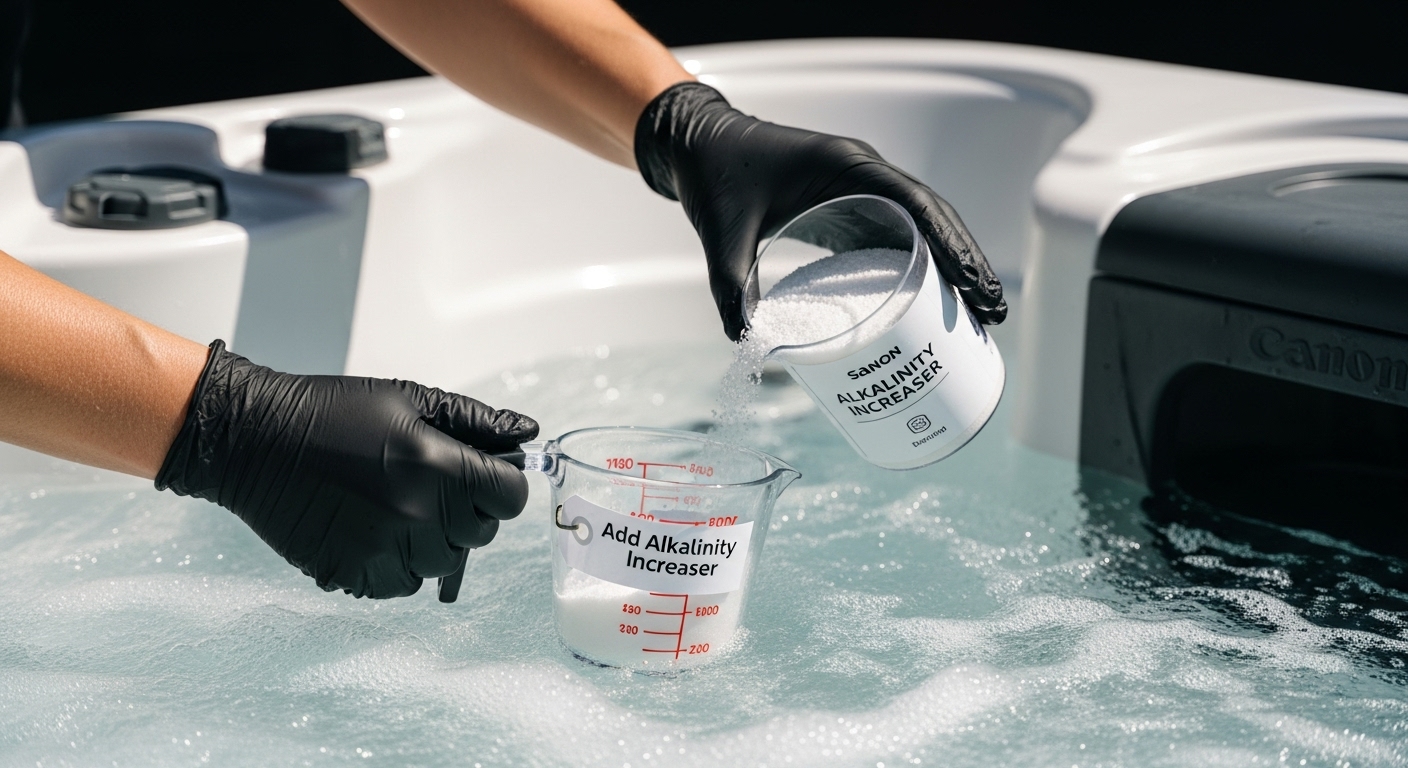
Before adding the alkalinity increaser, ensure your hot tub’s circulation system is running at full power. This helps distribute the chemicals evenly throughout the water. Wear protective gloves and safety glasses to prevent any potential chemical splashes. Measure the exact amount of alkalinity increaser you calculated in the previous step using a clean, dry measuring cup dedicated solely to hot tub chemicals.
Stand on the side of the hot tub and slowly pour the measured alkalinity increaser directly into the water while the jets are running. Pour in a wide, sweeping motion to help disperse the chemicals quickly and prevent any concentrated areas of chemical buildup. Avoid pouring the increaser near the skimmer or directly onto the hot tub surfaces. After adding the chemicals, allow the circulation system to run continuously for at least 15 to 20 minutes, ensuring thorough mixing and distribution.
Pay close attention to the water during and after the chemical addition.
 The water should remain clear, and you should not notice any cloudiness or unusual changes in colour. Wait approximately 30 minutes after adding the increaser before retesting the water to confirm you have successfully reached the desired alkalinity level. If the levels are not yet perfect, you can make small, incremental adjustments, but always wait and retest between additions to avoid overcorrection.
Step 4: Allow the water to circulate
Circulation is the critical process that ensures your alkalinity increaser disperses evenly and your hot tub water maintains a balanced chemical composition. Proper circulation prevents chemical stratification and helps integrate the newly added alkalinity increaser throughout the entire water volume. Explore our comprehensive water management guide to understand the science behind water movement.
Activate your hot tub’s circulation system at full power immediately after adding the alkalinity increaser. Most modern hot tubs have built-in pumps that can be set to high-speed circulation mode. Run the system continuously for at least 20 to 30 minutes, which allows the chemicals to mix thoroughly and reach every corner of the spa. During this time, keep the hot tub cover open to allow any potential chemical gases to dissipate safely.
Pay close attention to the water movement during circulation. The jets should create a consistent, swirling motion that indicates effective chemical distribution. If your hot tub has multiple jets, ensure they are positioned to create maximum water turbulence. Some hot tub owners make the mistake of running circulation at low speed, which can lead to uneven chemical distribution and potential hot spots of concentrated chemicals.
After the initial circulation period, monitor the water’s appearance and feel. The water should look clear and feel smooth, with no unusual cloudiness or residue. Any signs of excessive foam or unusual discolouration might indicate incomplete mixing or potential chemical imbalance. If you notice any irregularities, run the circulation system for an additional 15 minutes and then retest the water’s alkalinity to confirm proper integration of the chemical increaser.
Step 5: Re-test the alkalinity level after circulation
Re-testing your hot tub’s alkalinity level is the crucial final step in ensuring your water chemistry remains balanced and effective. After the circulation process, you need to verify that the alkalinity increaser has distributed evenly and achieved the desired result. Explore our comprehensive guide on alkalinity management to understand the nuances of this process.
Wait approximately 30 minutes after completing the circulation process before retesting. This waiting period allows the chemicals to fully integrate and stabilise throughout the water volume. Use the same digital testing kit or test strips you employed in the initial measurement, ensuring consistent and accurate results. Collect a water sample from approximately 30 centimetres below the surface, away from jet streams and skimmer areas, to get the most representative reading.
Carefully compare your new alkalinity reading with the target range of 80 to 120 parts per million (ppm). If the reading falls within this optimal range, you have successfully completed the alkalinity adjustment process. Should the reading be slightly below or above the target, you can make minor incremental adjustments. However, avoid overcorrecting, as dramatic chemical changes can destabilise your hot tub’s water chemistry and potentially damage the equipment.
If your alkalinity level remains significantly off target after this process, do not immediately add more chemicals. Instead, wait a few hours and retest, as sometimes water chemistry requires time to fully stabilise. Take detailed notes of your readings, chemical additions, and observations. This record-keeping will help you understand your hot tub’s unique chemical behaviour and make more precise adjustments in future maintenance cycles.
Step 6: Adjust further if necessary
Fine-tuning your hot tub’s alkalinity is a delicate process that requires patience and precision. Not all alkalinity adjustments will be perfect on the first attempt, so understanding how to make incremental corrections is crucial. Learn more about total alkalinity increasers to master this nuanced process.
If your initial alkalinity test reveals that the levels are still outside the ideal 80 to 120 parts per million (ppm) range, you will need to make careful, measured adjustments. When alkalinity is too low, add small quantities of sodium bicarbonate increaser using the same careful calculation method employed in earlier steps. Conversely, if alkalinity is too high, you might need to use a pH reducer to bring the levels back into balance. Always add chemicals in small increments, waiting 30 minutes between additions and retesting to prevent overcorrection.
Pay close attention to how chemical changes impact your overall water chemistry. Alkalinity and pH are interconnected, so adjusting one can influence the other. After each minor adjustment, run your hot tub’s circulation system for 15 to 20 minutes to ensure thorough mixing. Use your digital testing kit to monitor changes, recording each measurement to track the progression of your water balancing efforts. Remember that dramatic chemical swings can potentially damage your hot tub equipment or create an uncomfortable bathing environment.
If you find yourself consistently struggling to maintain stable alkalinity, this might indicate underlying issues with your water source or hot tub system. Consider consulting a professional hot tub technician who can perform a comprehensive water analysis and provide tailored advice for your specific setup. Persistent alkalinity problems could signal equipment malfunction or water quality issues that require expert intervention.
This troubleshooting table outlines common problems encountered when raising hot tub alkalinity, their likely causes, and suggested solutions based on guidance from the article.
| Problem | Possible Cause | Solution |
|---|---|---|
| pH levels remain unstable | Low alkalinity (<80 ppm) | Add alkalinity increaser as per volume and retest |
| Cloudy water or scale forms | High alkalinity (>120 ppm) | Use a pH reducer to lower alkalinity |
| Inaccurate or erratic results | Poor sampling or unreliable test kit | Use digital testing kit, sample away from inlets |
| Chemical residue/uneven mixing | Inadequate circulation or poor dosing method | Run jets at full power, pour increaser gradually |
| Overcorrection of levels | Adding too much increaser in one go | Add in small increments, retest before further dosing |
Simplify Your Alkalinity Adjustment with ClearSpa Experts
Struggling with unpredictable test results, unclear dosing, or water that just will not balance? If achieving the perfect alkalinity in your hot tub feels overwhelming, you are not alone. Many hot tub owners face the frustration of drifting alkalinity, unreliable test strips and the constant worry of damaging their spa or ending up with uncomfortable water. That is why reliable tools, accurate products and trusted support become essential for lasting results.
Do not leave your water balance to chance. Trust ClearSpa for top-quality hot tub chemicals, testing kits, and alkalinity increasers created for busy spa owners who want perfect water without the headache. Visit ClearSpa today to browse our rigorously tested spa treatments, find precise solutions that match exactly what you learned in this guide and ensure your hot tub is always crystal-clear and safe. Make your next soak your best ever. Shop now and experience the confidence that comes with expert-grade care for your spa.
Frequently Asked Questions
How do I test the alkalinity level in my hot tub?
To test the alkalinity level in your hot tub, use a digital water testing kit designed for hot tubs. Collect a water sample approximately 30 centimetres below the surface and follow the manufacturer’s instructions to obtain an accurate reading. The ideal alkalinity range is between 80 and 120 parts per million (ppm).
What should I do if the alkalinity level is too low?
If the alkalinity level is below 80 ppm, you should add an alkalinity increaser, typically sodium bicarbonate. Calculate the necessary amount based on your hot tub’s volume and current alkalinity level, then add it in small increments to avoid overshooting the target.
Can high alkalinity levels affect my hot tub?
Yes, high alkalinity levels (above 120 ppm) can lead to scale formation and cloudy water. It can also make it difficult to adjust the pH level, which can cause further issues with water balance. If levels are too high, consider using a pH reducer to correct the imbalance.
How long should I circulate the water after adding the alkalinity increaser?
After adding the alkalinity increaser, you should run your hot tub’s circulation system at full power for at least 15 to 20 minutes. This ensures that the chemicals are well distributed throughout the water for effective balancing.