How Do You Shock a Hot Tub: Step-by-Step Guide
Test and balance the water first, dissolve a spa-specific shock in a bucket of water, add it with the jets running and the cover open for 20-30 minutes, then wait until chlorine returns to 3-5 mg/l before bathing. Follow the product label and wear gloves and eye protection.
Learn how do you shock a hot tub naturally with this step-by-step guide for maintaining clean and safe hot tub water.
Maintaining crystal clear hot tub water sounds simple until you discover the sheer precision involved in shocking a spa safely. Most people reach straight for pool chemicals or guess at dosages, but that shortcut can cause serious damage or leave water dangerously unclean. Fascinatingly, shocking with the wrong product or dose can create more problems than it solves, with many shocks requiring just 2 ounces per 500 gallons for total effectiveness. Miss this detail and you could be risking your health or your hot tub investment.
Table of Contents
- Step 1: Gather The Necessary Supplies And Materials
- Step 2: Test The Water Chemistry Before Shocking
- Step 3: Determine The Right Shock Dosage
- Step 4: Add The Shock Treatment To The Hot Tub
- Step 5: Allow The Hot Tub To Circulate And Verify Levels
Quick Summary
| Key Point | Explanation |
|---|---|
| 1. Gather required hot tub supplies | Prepare specific supplies like chlorine shock, pH strips, and protective gear before starting. |
| 2. Test water chemistry accurately | Use reliable testing strips or digital kits to measure pH, alkalinity, and sanitiser levels before shocking your hot tub. |
| 3. Calculate the correct shock dosage | Determine the right amount of shock treatment based on your hot tub’s volume and current water chemistry for effective results. |
| 4. Pre-dissolve shock treatment | Always dissolve shock treatment in water before adding it to prevent damage to the hot tub’s surfaces. |
| 5. Allow proper time for circulation and testing | Keep jets running after shocking, wait 24-48 hours, and retest water to ensure sanitiser levels are safe before use. |
Step 1: Gather the necessary supplies and materials
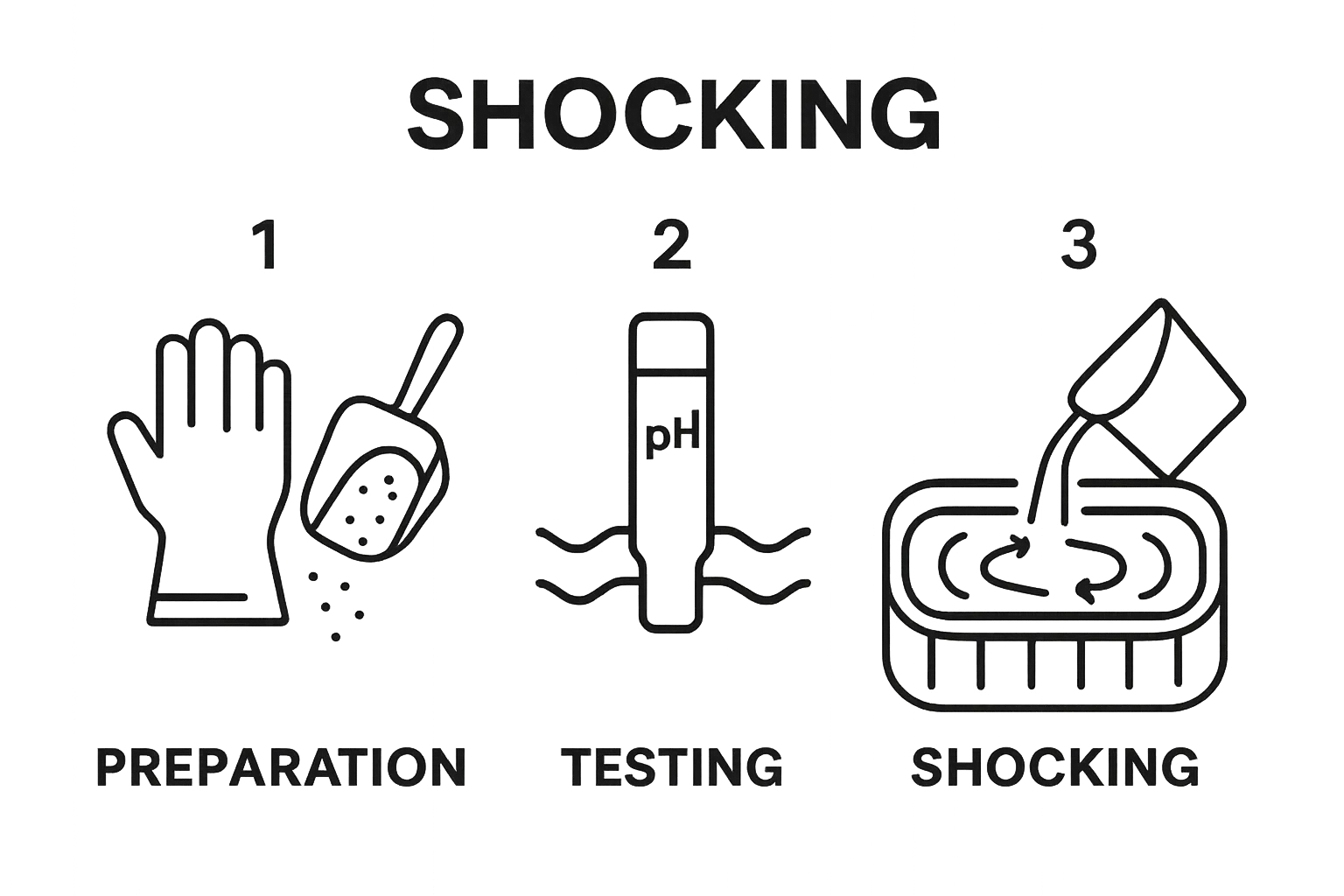
Preparing to shock your hot tub requires strategic planning and the right equipment. This initial step sets the foundation for a successful water treatment process, ensuring you have all necessary materials ready before beginning the shocking procedure. The key is organisation and selecting high-quality supplies specifically designed for hot tub maintenance.
To effectively shock your hot tub, you will need several critical items. Your primary supplies should include chlorine-based shock treatment, which comes in granular or powdered form specifically formulated for spa use. Do not substitute this with standard swimming pool shock, as hot tub shock has different concentration levels and chemical compositions.
Your essential equipment checklist will involve:
- Hot tub shock treatment (spa-specific granules)
- Clean measuring cup or designated scoop
- Protective rubber gloves
- Safety goggles
- Clean bucket for mixing (if required)
- pH testing strips
- Thermometer
Before purchasing your shock treatment, check your hot tub manufacturer’s recommendations for specific product compatibility. Some brands have proprietary shock treatments that work optimally with their system. Water Treatment Specialists recommend selecting a shock treatment matching your hot tub’s specific sanitisation requirements.
Protective gear is equally important during this process. Rubber gloves prevent direct chemical contact with your skin, while safety goggles protect your eyes from potential splashes. Chemicals used in hot tub shocking can be potent, so personal protection should never be overlooked.
When selecting your shock treatment, consider factors like chlorine concentration, ease of use, and compatibility with your existing water chemistry. Granular chlorine shock treatments typically provide the most straightforward application method for hot tubs. Look for products explicitly labelled for spa or hot tub use, as these are formulated to work effectively in smaller water volumes with different chemical balances compared to swimming pools.
A clean, dedicated measuring tool is crucial for accurate dosing. Do not use kitchen utensils or containers that might have residual food or cleaning product traces, as these could interfere with the chemical balance. A precise measurement ensures you neither under nor over-shock your hot tub, which could compromise water quality and potentially damage your spa’s equipment.
By meticulously gathering these supplies before beginning the shocking process, you create a safe, efficient environment for maintaining your hot tub’s water quality. Preparation is the cornerstone of successful hot tub maintenance.
Below is a table summarising the essential tools and materials required for shocking a hot tub, including their purpose and any important specifications to note.
| Item | Purpose | Important Notes |
|---|---|---|
| Chlorine-based shock (granules) | Sanitises and restores water clarity | Use spa/hot tub-specific product only |
| Clean measuring cup/scoop | Ensures accurate dosage | Do not use kitchen or multipurpose utensils |
| Protective rubber gloves | Protects hands from chemical exposure | Wear throughout handling and measuring |
| Safety goggles | Shields eyes from potential splashes | Non-negotiable for chemical mixing |
| Clean bucket | Used to pre-dissolve granular shock | Must be free of contaminants; reserved for this use |
| pH testing strips/digital kit | Measures water chemistry levels | Digital kits offer greater precision |
| Thermometer | Verifies water temperature for effective treatment | Maintain standard hot tub range during shocking |
Step 2: Test the water chemistry before shocking
Testing your hot tub water chemistry is a critical preparatory step that determines the effectiveness of your shock treatment. This phase helps you understand the current state of your water, ensuring you apply the right type and amount of shock to restore balance and sanitisation.[1] Accurate water testing prevents potential damage to your hot tub and guarantees optimal water quality.
To begin, you will need reliable pH testing strips and a digital water testing kit. These tools provide precise measurements of critical chemical parameters. Digital testers offer more accurate readings compared to traditional test strips, though both can be effective when used correctly. Water Treatment Specialists recommend digital testing for the most comprehensive water analysis.
Your primary testing focus should involve measuring several key parameters:
- pH levels (ideal range between 7.2 and 7.6)
- Total alkalinity (ideal range between 80 and 120 parts per million)
- Sanitiser levels (chlorine or bromine)
- Calcium hardness
Carefully remove a water sample from the centre of your hot tub, away from jet streams and surface areas. Submerge your testing strip or digital probe according to manufacturer instructions, ensuring you do not introduce external contaminants. Hold the strip or probe steady for the recommended duration, typically between 15 to 30 seconds.
Reading and interpreting your test results requires careful attention. Imbalanced water chemistry can significantly impact shock treatment effectiveness.[2] If your pH levels are too high or low, the shock treatment will not work efficiently. Alkalinity acts as a buffer, helping stabilise pH levels, so maintaining this parameter is crucial.
Should your sanitiser levels be low, this indicates a higher likelihood of bacterial growth and necessitates a more aggressive shock treatment. Conversely, excessively high sanitiser levels might require dilution or partial water replacement before shocking.
For calcium hardness, look for readings between 150 and 250 parts per million. Water that is too soft can corrode hot tub equipment, while water that is too hard can cause scale buildup and reduced heating efficiency.
If your initial test reveals significant chemical imbalances, you might need to adjust your water chemistry before proceeding with shock treatment. This could involve adding pH increasers or decreasers, alkalinity stabilisers, or performing a partial water change. You can learn more about water management treatments to understand these processes in greater depth.
Remember that consistent and accurate water testing is the foundation of effective hot tub maintenance. By taking the time to thoroughly assess your water chemistry, you set the stage for a successful shocking procedure that will keep your hot tub clean, safe, and enjoyable.
Step 3: Determine the right shock dosage
Determining the correct shock dosage is a precision task that requires careful calculation based on your hot tub’s specific volume and current water chemistry. This step is crucial because an incorrect dosage can either leave your water inadequately sanitised or potentially damage your hot tub’s equipment and surfaces.
The primary factor in calculating shock dosage is your hot tub’s total water volume. Most residential hot tubs range between 300 to 500 gallons, but it is essential to know your specific capacity precisely. Consult your hot tub’s manual or measure the volume directly to ensure accurate dosing. Water Treatment Experts emphasise that precise measurement is the foundation of effective water treatment.
Your dosage calculation will depend on several critical factors:
- Total water volume
- Current sanitiser levels
- Frequency of hot tub usage
- Recent contamination events
- Water chemistry test results
Chlorine-based shock treatments typically require approximately 2 ounces of granular shock per 500 gallons of water. However, this is a general guideline, and your specific product might have different recommendations. Always carefully read the manufacturer’s instructions on the shock treatment packaging for the most accurate dosage guidance.
If your water test revealed low sanitiser levels or you have experienced heavy usage, you might need a more aggressive shock treatment. In such scenarios, you could require up to 4 ounces of shock per 500 gallons. Conversely, if your water chemistry is relatively balanced and usage has been minimal, a lighter dose might suffice.
Special consideration must be given to factors that increase the need for shock treatment. These include multiple people using the hot tub, visible water cloudiness, unusual odours, or if the spa has been unused for an extended period. Each of these conditions might necessitate a slightly higher shock dosage to effectively eliminate contaminants and restore water clarity.[1]
Before adding shock, ensure your hot tub jets are running to facilitate even distribution. This helps the shock treatment circulate thoroughly and work more effectively. Measure your shock treatment precisely using the provided scoop or a clean, dedicated measuring cup. Never estimate or guess the amount, as this can lead to improper water chemistry.
You can explore more detailed information about non-chlorine shock treatments if you prefer alternative sanitisation methods. Some non-chlorine shock treatments have different dosage requirements and work slightly differently compared to traditional chlorine-based shocks.
After adding the shock treatment, allow the hot tub to circulate for at least 20 minutes with the cover open. This enables proper chemical dispersion and helps release potential gas byproducts. Wait until the sanitiser levels return to a safe range before allowing anyone to use the hot tub, typically within 24 to 48 hours depending on the specific shock treatment used.
Step 4: Add the shock treatment to the hot tub
Adding shock treatment to your hot tub is a delicate process that requires precision, careful handling, and a methodical approach. This critical step transforms your water chemistry, eliminating contaminants and restoring pristine water quality.[1] Proper application ensures effective sanitisation and prevents potential damage to your hot tub’s surfaces and equipment.
Before beginning, double-check that you are wearing protective rubber gloves and safety goggles. Chemical splashes can cause skin irritation or eye damage, so personal protection is non-negotiable. Ensure you are in a well-ventilated area, preferably outdoors or in a space with good air circulation.
Your shock treatment application process should follow these key principles:
- Measure the shock treatment precisely
- Distribute the shock evenly
- Avoid direct contact with hot tub surfaces
- Maintain active water circulation
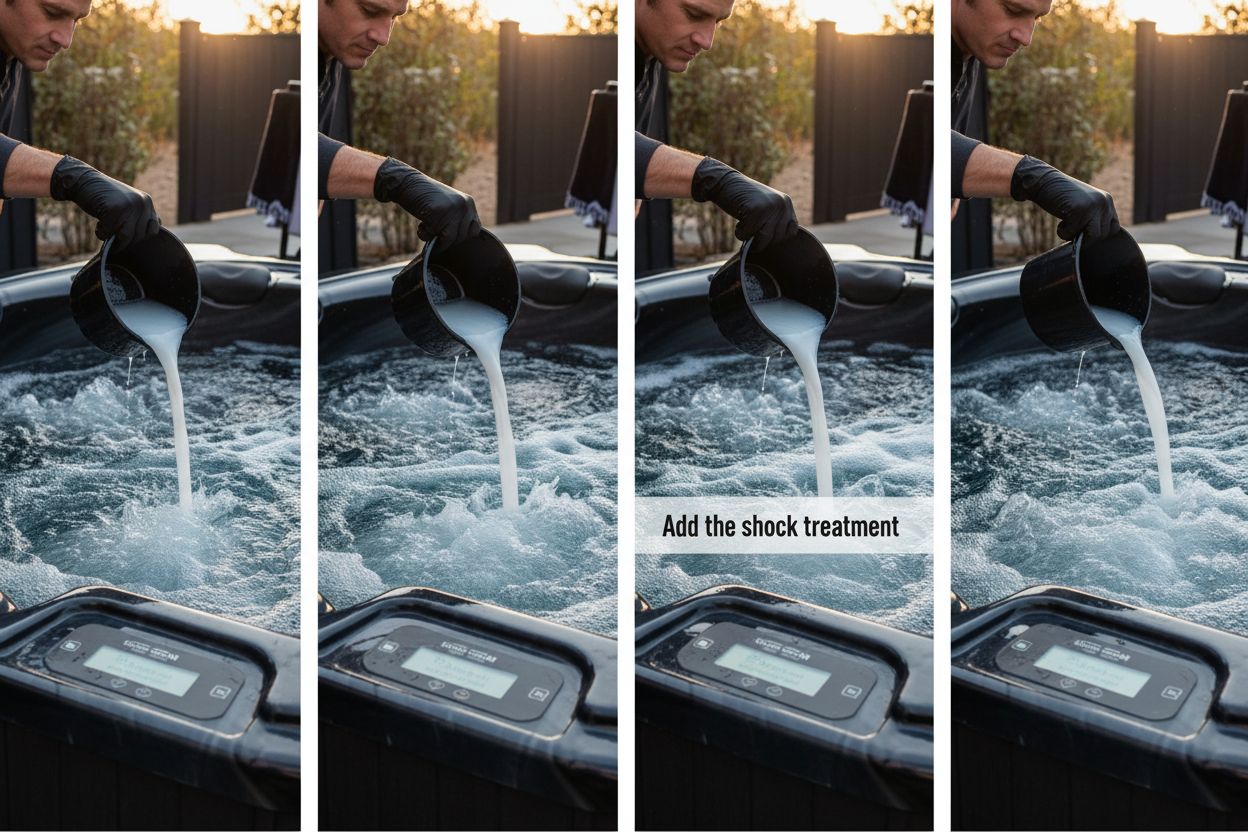
Carefully pre-dissolve granular shock treatment in a clean bucket filled with hot tub water before adding it to the spa. This method prevents undissolved granules from settling on surfaces, which could potentially bleach or damage your hot tub’s liner or acrylic finish. Stir the mixture gently but thoroughly to ensure complete dissolution.
With your jets running at medium speed, slowly pour the dissolved shock treatment into the water. The circulating water helps distribute the chemicals evenly, preventing concentrated areas that could potentially damage your hot tub. Water Treatment Experts recommend maintaining jet circulation for at least 20 minutes after shock treatment application to ensure complete dispersion.
Be mindful of the timing and environmental conditions during shock treatment. Avoid shocking your hot tub during direct sunlight, as UV rays can diminish the effectiveness of chlorine-based treatments. Early morning or evening hours provide optimal conditions for shock treatment, allowing the chemicals to work efficiently without rapid degradation.
Once you have added the shock treatment, keep the hot tub cover open for at least 20 to 30 minutes. This allows chemical gases to dissipate and prevents potential pressure buildup. The open cover also facilitates better air circulation, supporting the shock treatment’s chemical reactions.
You can explore our comprehensive guide to hot tub chemicals for additional insights into maintaining water quality. Understanding the nuances of chemical treatments can significantly enhance your hot tub maintenance routine.
After application, avoid using the hot tub immediately. Wait until sanitiser levels return to a safe range, typically 24 to 48 hours depending on the specific shock treatment used. Test the water chemistry again before resuming normal hot tub usage to ensure optimal safety and comfort.
Step 5: Allow the hot tub to circulate and verify levels
After adding shock treatment, the crucial phase of circulation and level verification begins. This step ensures that the chemicals distribute evenly and your hot tub water returns to a safe, balanced state. Proper circulation and meticulous level checking are fundamental to maintaining water quality and protecting your hot tub’s intricate systems.
Keep your hot tub jets running at medium speed for at least 20 to 30 minutes following shock treatment. This continuous water movement helps distribute the chemicals uniformly, preventing potential localised concentration that could damage surfaces or create uneven sanitisation. The circulating water also supports the chemical reaction, helping break down contaminants more effectively.
Your verification process should focus on these critical parameters:
- Sanitiser levels
- pH balance
- Total alkalinity
- Water clarity
- Potential chemical odours
Using your digital water testing kit or reliable test strips, check the water chemistry approximately one hour after shock treatment. Ideal sanitiser levels should range between 3 to 5 parts per million for chlorine or 4 to 6 parts per million for bromine.[3] If levels fall outside these ranges, you might need to make minor adjustments or conduct another shock treatment.
Water Treatment Experts recommend paying close attention to pH levels, which should remain between 7.2 and 7.6.[2] Extreme pH variations can reduce shock treatment effectiveness and potentially cause skin irritation or equipment damage.
Visually inspect your hot tub water during this process. Clear, sparkling water indicates successful shock treatment. If the water remains cloudy or exhibits a persistent unusual odour, this might suggest incomplete sanitisation or underlying water chemistry issues. In such cases, wait another 24 hours and retest, or consider consulting a professional.
Temperature plays a significant role in chemical effectiveness. Ensure your hot tub maintains its standard operating temperature during and after shock treatment. Significant temperature fluctuations can impact chemical performance and potentially compromise sanitisation efforts.
You can explore our comprehensive hot tub maintenance guide for additional insights into water care. Understanding these nuanced maintenance techniques helps prolong your hot tub’s life and ensures a consistently enjoyable experience.
Before resuming normal hot tub use, confirm that sanitiser levels have stabilised and water chemistry matches recommended parameters.
The following table provides a quick checklist for verifying hot tub water quality and safety after shocking, based on steps and ranges already detailed above.
| Parameter | Ideal Range/Condition | Verification Method | Next Action if Not Met |
|---|---|---|---|
| Sanitiser (Chlorine) | 3-5 ppm | Test strip or digital kit | Wait/retest or perform secondary shock |
| Sanitiser (Bromine) | 4-6 ppm | Test strip or digital kit | Same as above |
| pH Level | 7.2-7.6 | Test strip or digital kit | Adjust with pH increaser/decreaser |
| Total Alkalinity | 80-120 ppm | Test strip or digital kit | Add stabiliser or partial water change |
| Water Clarity | Clear and sparkling | Visual inspection | Wait, run jets, or consult a professional |
| Odour | No strong or unusual odour | Sense check | Allow further circulation/retest |
| Temperature | Within standard hot tub range | Thermometer | Adjust heater and maintain temperature |
Remember, patience is key in hot tub water management. Rushing the process can lead to ineffective treatment or potential damage to your spa’s delicate systems.
Take Charge of Your Hot Tub’s Water Quality with ClearSpa Solutions
If you have ever felt uncertain when shocking your hot tub, you are not alone. Many hot tub owners struggle with finding the right shock dosage, selecting reliable chemicals, and maintaining balanced water after treatment. The need for precise dosing, safe handling of spa-specific shock, and accurate water testing can leave you feeling overwhelmed and anxious about water safety and equipment protection. This article has helped you master these vital steps. Now, imagine making each part of your maintenance routine simpler and more reliable.
Explore the benefits of using trusted products from ClearSpa. From high-grade hot tub chemical solutions to expert guidance on water management treatments, you can streamline your shock treatment process and maintain safer, clearer water every time. Do not risk a poor shock by using generic or incompatible supplies. Browse the specially crafted range on our main site and upgrade your routine today for guaranteed results and lasting peace of mind.
Frequently Asked Questions
What supplies do I need to shock a hot tub?
You will need a chlorine-based shock treatment designed for spas, a clean measuring cup, protective rubber gloves, safety goggles, a clean bucket for mixing (if required), pH testing strips, and a thermometer.
How do I test the water chemistry before shocking?
Use reliable pH testing strips or a digital water testing kit to measure pH levels, total alkalinity, sanitiser levels, and calcium hardness. Ensure you collect the water sample from the centre of the hot tub for accurate results.
How do I determine the right shock dosage for my hot tub?
Calculate based on your hot tub’s water volume, current sanitiser levels, and any recent usage or contamination events. As a general rule, use approximately 2 ounces of granular shock per 500 gallons of water, adjusting as needed based on your test results and specific conditions.
How long should I wait before using my hot tub after shocking?
Typically, you should wait 24 to 48 hours after adding the shock treatment, until sanitiser levels return to a safe range. Test the water chemistry again to ensure it’s safe for use.
Recommended
Sources and review
Reviewed on . Next review due .
- PWTAG technical notes on pool and spa water treatment - Pool Water Treatment Advisory Group
- Guidelines for safe recreational water environments. Volume 2: swimming pools and similar environments - World Health Organization
- HSG282: The control of legionella and other infectious agents in spa-pool systems - Health and Safety Executive